
Published: 29 May 2026, 09:00PM
Introduction
Government contracting presents enormous growth opportunities for businesses across industries, especially in IT services, cybersecurity, cloud computing, AI, engineering, staffing, and professional consulting. Federal, state, and local agencies continue investing heavily in modernization initiatives, digital transformation, infrastructure projects, and mission-critical services.
However, many contractors make the mistake of pursuing every available solicitation. Chasing too many opportunities often leads to wasted resources, proposal burnout, lower win rates, and reduced profitability. Proposal teams become overwhelmed, capture efforts lose focus, and organizations struggle to compete effectively against more strategic competitors.
Successful contractors understand that growth in government contracting is not about bidding on everything. It is about identifying the right opportunities that align with organizational capabilities, past performance, customer relationships, and long-term business goals.
This is where a strong government capture strategy becomes essential.
A well-developed capture strategy helps contractors evaluate opportunities before the Request for Proposal (RFP) stage, improve competitive positioning, strengthen agency relationships, and increase overall win probability. Instead of reacting to released solicitations, businesses proactively prepare for opportunities long before proposals are submitted.
Organizations that invest in capture management gain significant advantages in federal contracting. They position themselves earlier, understand agency priorities better, build strategic partnerships, and create more compelling win strategies.
In today’s highly competitive government contracting environment, capture strategy is no longer optional. It is a critical component of sustainable growth and long-term contract success.
What is the Government Capture Strategy?
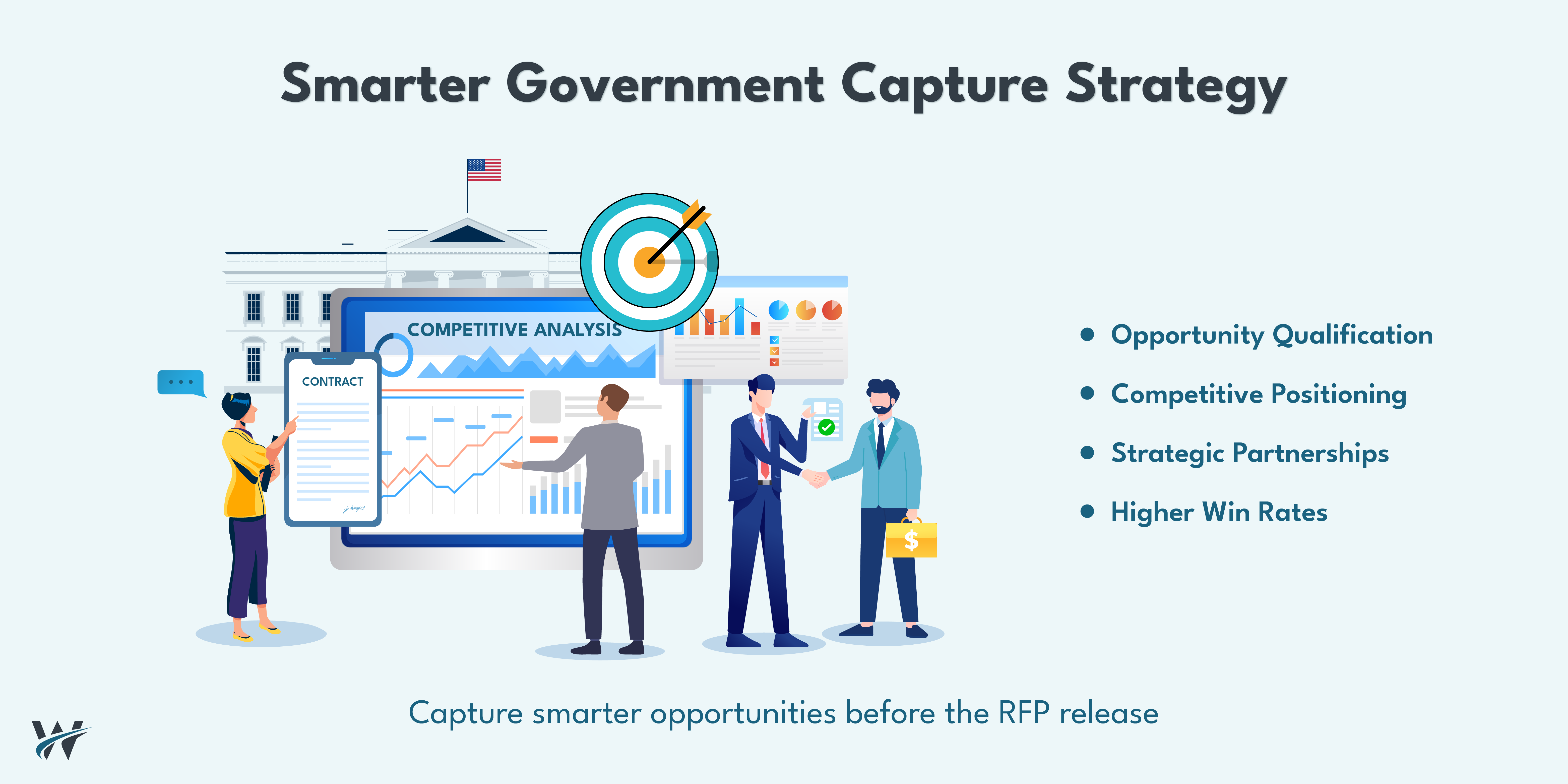
Government capture strategy is the structured process of identifying, qualifying, analyzing, and positioning for government contract opportunities before formal proposal development begins.
Capture management focuses on proactive planning rather than reactive bidding. It helps organizations determine which opportunities are worth pursuing and how to improve their chances of winning.
The goal of capture strategy is simple: pursue smarter opportunities with higher win potential.
Instead of waiting for an RFP release, capture teams begin gathering intelligence months or even years in advance. They analyze agency needs, monitor procurement forecasts, assess competitors, build customer relationships, and develop strategic positioning.
A comprehensive government capture strategy typically focuses on several core areas:
Opportunity Qualification
Not every opportunity is a good fit. Capture teams evaluate whether the contract aligns with the company’s capabilities, certifications, past performance, technical expertise, and revenue goals.
Competitive Positioning
Understanding the competitive landscape helps organizations identify strengths, weaknesses, and differentiators that can improve proposal positioning.
Agency Engagement
Successful capture efforts involve early communication and relationship building with government stakeholders, contracting officers, and program managers.
Teaming Strategy
Many government opportunities require partnerships. Capture management helps businesses identify subcontractors, joint venture partners, or prime contractors that complement their capabilities.
Win Planning
Capture teams create strategies that define how the organization will deliver value, solve agency challenges, and outperform competitors.
Ultimately, government capture strategy creates a roadmap for pursuing opportunities efficiently and strategically.
Why Government Capture Strategy Matters
Organizations that implement strong capture strategies consistently improve their federal contracting success rates. Capture management provides structure, intelligence, and strategic direction throughout the business development lifecycle.
Below are some of the most important reasons why capture strategy matters.
One of the biggest mistakes contractors make is pursuing low-probability opportunities.
Without proper qualification processes, companies often spend large amounts of time and money responding to contracts they are unlikely to win. Proposal development requires significant investment, including labor costs, subject matter experts, pricing resources, compliance reviews, and management oversight.
Capture strategy helps organizations focus only on high-value, best-fit opportunities.
Qualified opportunities generally align with:
By pursuing the right opportunities, contractors improve efficiency, reduce proposal waste, and increase overall profitability.
Government contracting is highly competitive. Many solicitations attract experienced incumbents and well-established competitors.
Capture strategy helps organizations understand the competitive landscape early in the process.
Competitive analysis may include:
This intelligence allows contractors to position themselves more effectively before the RFP is released.
Strong competitive positioning enables businesses to highlight unique value propositions such as:
Early positioning creates stronger proposal messaging and improves win probability.
Capture strategy directly improves proposal quality.
When capture activities are completed before the solicitation release, proposal teams have access to critical information that strengthens the final response.
Capture insights help proposal teams understand:
This intelligence enables proposal writers to create more targeted, persuasive, and customer-focused content.
Instead of writing generic proposals, organizations can tailor solutions specifically to agency goals and operational challenges.
Strong capture management also improves proposal readiness by allowing teams to:
As a result, proposal development becomes faster, more organized, and more effective.
Government contracting is heavily relationship driven.
Agencies prefer contractors that understand their missions, priorities, and operational challenges. Capture strategy emphasizes early engagement with government stakeholders before procurements are formally released.
Relationship building may involve:
These interactions help contractors gain valuable insights into customer priorities while building credibility and trust.
Strong agency relationships often provide better visibility into:
Contractors that engage early are better positioned to shape solutions and align offerings with agency expectations.
Key Elements of a Strong Government Capture Strategy
An effective capture strategy requires structured planning, detailed research, and ongoing market intelligence. Below are the most important components of successful government capture management.
Agency Research
Understanding the agency is one of the most important aspects of capture strategy.
Contractors must research:
Agency research helps organizations align their solutions with actual customer needs rather than making assumptions.
For example, a federal agency investing heavily in cloud modernization may prioritize contractors with strong Azure, AWS, or hybrid cloud expertise. Similarly, agencies focused on cybersecurity initiatives may seek contractors with advanced compliance and security certifications.
Research also helps contractors identify:
The better organizations understand the agency environment, the more effectively they can position their solutions.
Competitor Analysis
Competitive intelligence is a critical part of government capture strategy.
Organizations must understand who they are competing against and how to differentiate themselves.
Competitor analysis typically includes:
This information helps businesses develop smarter positioning strategies.
For example, if an incumbent contractor has strong technical capabilities but poor customer responsiveness, a challenger may position itself around service quality, communication, and operational agility.
Competitive analysis also helps organizations decide whether an opportunity is realistically winnable.
If a solicitation heavily favors an incumbent with deep agency relationships and proprietary systems knowledge, contractors may decide not to pursue the opportunity unless they have strong differentiators.
Partner Identification
Government contracts often require multiple capabilities, certifications, and delivery resources.
Teaming strategies help organizations strengthen their overall solution offerings.
Capture teams identify strategic partners such as:
Strong partnerships can improve eligibility for set-aside contracts, expand technical capabilities, and increase delivery capacity.
Successful teaming arrangements require:
Building partnerships early during capture management provides more time for coordination and proposal planning.
Win Theme Development
Win themes are the core messages that explain why the contractor is the best choice for the opportunity.
Strong win themes focus on customer value rather than generic company descriptions.
Effective win themes may highlight:
Win themes should align directly with agency priorities and evaluation criteria.
Capture teams often begin developing win themes long before proposal writing starts. Early messaging development improves consistency across proposal sections, oral presentations, and customer interactions.
Common Government Capture Strategy Mistakes
Even experienced contractors make capture management mistakes that reduce win probability.
Below are some of the most common capture strategy challenges organizations should avoid.
Pursuing Low-Probability Opportunities
One of the biggest problems in government contracting is over-pursuit.
Some organizations chase every solicitation regardless of fit, resulting in:
Successful contractors establish clear qualification criteria to prioritize high-value opportunities.
Weak Competitive Analysis
Failing to understand the competition creates major strategic disadvantages.
Without competitive intelligence, contractors may:
Strong competitive analysis improves positioning and proposal strategy.
Late Engagement with Agencies
Waiting until the RFP release to engage with agencies limits visibility and positioning opportunities.
Early engagement helps contractors:
Best Practices for Improving Government Capture Strategy
Organizations can strengthen capture management by implementing several proven best practices.
Develop Formal Qualification Processes
Create clear go/no-go criteria based on:
This improves opportunity selection.
The Future of Government Capture Management
Government contracting continues evolving rapidly due to technology modernization, cybersecurity demands, AI adoption, cloud transformation, and digital government initiatives.
As procurement environments become more competitive, contractors must adopt more advanced capture management approaches.
Future capture strategies will increasingly rely on:
Organizations that modernize capture operations will gain stronger visibility, better qualification capabilities, and improved decision-making.
Businesses that treat capture management as a strategic investment rather than an administrative process will remain more competitive in the federal marketplace.
Conclusion
Government capture strategy plays a critical role in helping contractors identify high-value opportunities, improve competitive positioning, and increase contract win rates.
Instead of pursuing every available solicitation, successful organizations focus on opportunities that align with their expertise, capabilities, customer relationships, and long-term business objectives.
Effective capture management improves opportunity qualification, strengthens proposal development, enhances agency engagement, and supports smarter business decisions.
By investing in structured capture processes, competitor analysis, strategic partnerships, and early customer engagement, contractors can significantly improve their success in government contracting.
In today’s highly competitive federal market, organizations that implement proactive and disciplined capture strategies will be better positioned for sustainable growth and long-term contract success.
Call to Action
Looking to improve your government capture strategy and increase federal contract win rates?
Our team helps businesses identify high-value opportunities, strengthen capture planning, improve competitive positioning, and streamline proposal development for government contracting success.
Contact us today to learn how our federal capture and proposal support services can help your organization pursue smarter opportunities and win more contracts.