
Introduction
In federal contracting, proposal teams dedicate significant time and resources to developing technical solutions, management approaches, staffing plans, compliance matrices, and pricing strategies. Yet despite the extensive effort invested in these sections, one of the most influential components of a proposal is often treated as an afterthought: the executive summary.
Many organizations spend weeks preparing highly detailed proposal volumes only to rush through the executive summary shortly before submission. This can be a costly mistake. The executive summary is often the first section evaluators read, and it frequently shapes their perception of the proposal before they review technical details.
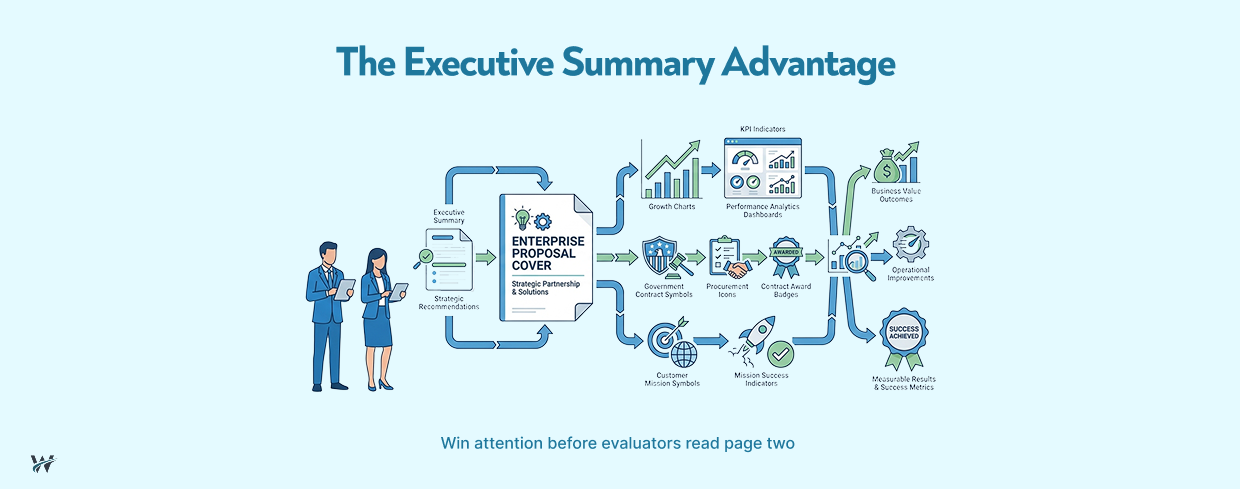
A well-crafted executive summary does more than summarize proposal content. It demonstrates customer understanding, communicates value, highlights differentiators, and creates a compelling narrative that aligns with agency priorities. In many cases, it serves as the bridge between compliance and persuasion.
For contractors pursuing federal opportunities, developing strong executive summaries can significantly improve proposal effectiveness and increase overall win probability.
Why Executive Summaries Matter in Federal Proposals
Federal evaluators often review dozens, and sometimes hundreds, of proposals during a procurement cycle. These evaluators face strict timelines and substantial amounts of information.
A strong executive summary helps evaluators quickly understand why your organization is the best choice.
Creates a Strong First Impression
First impressions matter in proposal evaluations. The executive summary often provides the initial opportunity to establish credibility and position your company as a trusted partner.
When evaluators immediately see that a contractor understands the agency's mission and challenges, they are more likely to view the remainder of the proposal positively.
Improves Proposal Readability
Federal proposals can be lengthy and highly technical. Evaluators appreciate concise, well-organized summaries that clearly explain the solution and expected outcomes.
A strong executive summary acts as a roadmap for the proposal and helps reviewers navigate complex information more efficiently.
Reinforces Customer Understanding
Agencies want contractors who understand their objectives, challenges, and mission requirements.
An effective executive summary demonstrates that the proposal team has invested time in understanding the agency's environment, strategic goals, and operational needs.
Highlights Key Differentiators
Many proposals meet basic requirements. What often separates winning proposals from losing proposals is the ability to clearly communicate unique value.
The executive summary provides an ideal platform for emphasizing differentiators that set your organization apart from competitors.
Supports Higher Evaluation Scores
While evaluation methodologies vary by agency and procurement, a compelling executive summary can strengthen evaluator confidence and improve the overall perception of the proposal.
When evaluators understand the benefits of a solution from the beginning, they can more easily connect proposal content to evaluation criteria throughout the review process.
The Purpose of an Executive Summary
One common misconception is that an executive summary simply summarizes proposal sections.
In reality, the executive summary serves a much broader purpose.
A winning executive summary should answer several key questions:
Rather than functioning as a table of contents, the executive summary should present a persuasive business case that aligns with the agency's priorities.
What Makes a Strong Executive Summary
Successful executive summaries share several common characteristics.
Focus on Agency Challenges
The most effective executive summaries begin with the customer, not the contractor.
Instead of leading with company history or organizational achievements, focus on the agency's mission, challenges, objectives, and desired outcomes.
Demonstrate a clear understanding of:
When agencies see their challenges accurately reflected, they gain confidence that the contractor understands their environment.
Present Outcomes Instead of Features
A common proposal mistake is emphasizing technical features without explaining their impact.
Federal buyers are interested in results.
Rather than focusing exclusively on technology, tools, methodologies, or processes, explain the outcomes those capabilities will deliver.
For example:
Instead of saying:
"Our solution includes automated workflow technology and cloud-based analytics."
Focus on:
"Our solution reduces processing times, improves decision-making visibility, and supports mission-critical performance objectives."
Outcome-oriented messaging resonates more effectively with evaluators because it connects capabilities directly to agency benefits.
Highlight Key Differentiators
Competitive procurements often involve multiple highly qualified contractors.
Your executive summary should clearly explain what makes your organization different.
Potential differentiators may include:
Differentiators should be specific, relevant, and supported by evidence whenever possible.
Avoid vague claims such as:
Instead, provide measurable proof that demonstrates value.
Keep Messaging Clear and Concise
Federal evaluators review large volumes of information under tight deadlines.
Clarity is essential.
Strong executive summaries use:
Avoid excessive jargon, acronyms, and highly technical descriptions unless necessary.
The goal is to make complex solutions easy to understand.
Align with Evaluation Factors
One of the most important proposal writing best practices is aligning every section with solicitation requirements.
The executive summary should reinforce the evaluation criteria outlined in the Request for Proposal (RFP).
These may include:
When executive summary messaging mirrors agency priorities, evaluators can more easily recognize proposal strengths
.
Structuring an Effective Executive Summary
While formats vary across opportunities, many successful executive summaries follow a similar structure.
Begin by demonstrating an understanding of the agency's mission, goals, and challenges.
This section should show evaluators that your team understands what success looks like from their perspective.
Provide a concise overview of the solution being offered.
Focus on how the solution addresses agency requirements and objectives.
Highlight measurable outcomes and benefits.
Examples may include:
Clearly explain why your organization is uniquely positioned to deliver success.
Include relevant experience, capabilities, certifications, and performance achievements.
Conclude with a strong value-focused message that reinforces the benefits of selecting your organization.
This section should leave evaluators with a clear understanding of why your proposal represents the best value.
Common Executive Summary Mistakes
Even experienced proposal teams can make mistakes that reduce executive summary effectiveness.
Generic Company Introductions
Many executive summaries begin with lengthy descriptions of company history.
While organizational background is important, agencies care most about how you will solve their challenges.
Focus on the customer before discussing your organization.
Overly Technical Content
Technical details belong in technical volumes.
An executive summary should remain accessible to both technical and non-technical evaluators.
Excessive complexity can reduce readability and dilute key messages.
Lack of Customer Focus
Some executive summaries focus almost entirely on contractor capabilities.
Winning proposals focus on customer outcomes.
The agency's needs should remain the central theme throughout the document.
Weak Value Propositions
A value proposition explains why a customer should choose your organization.
Weak value propositions often rely on generic statements that fail to communicate measurable benefits.
Strong value propositions connect capabilities to mission success.
Repetition of Proposal Content
The executive summary should not simply repeat content from other proposal sections.
Instead, it should synthesize key information into a compelling narrative that emphasizes value and customer benefits.
Failure to Quantify Benefits
Whenever possible, support claims with measurable results.
Examples include:
Quantifiable benefits are more persuasive than broad claims.
Best Practices for Writing Winning Executive Summaries
Organizations seeking to improve proposal win rates should adopt several proven best practices.
Start Early
Do not wait until the final days before submission.
Executive summaries should be developed throughout the proposal process as solution details evolve.
Collaborate Across Teams
Proposal managers, capture managers, solution architects, technical writers, and subject matter experts should contribute to executive summary development.
Collaboration ensures accuracy and consistency.
Tailor Every Submission
Avoid reusing generic executive summaries.
Each federal opportunity has unique requirements, priorities, and evaluation criteria.
Customization demonstrates customer understanding and improves relevance.
Use Customer-Centric Language
Shift messaging from "we" to "you."
Focus on how the agency benefits from your solution.
This approach creates stronger customer engagement.
Include Visual Elements When Appropriate
Depending on proposal requirements, graphics, diagrams, and benefit tables can improve readability and reinforce key messages.
Visual content helps evaluators quickly absorb important information.
Review for Compliance and Persuasiveness
Executive summaries should undergo both compliance reviews and quality reviews.
Ensure messaging aligns with solicitation requirements while remaining persuasive and customer-focused.
The Relationship Between Capture Management and Executive Summaries
Strong executive summaries often begin long before proposal writing starts.
Successful capture management activities provide valuable insights that strengthen executive summary development.
Capture teams help identify:
When capture intelligence is integrated into executive summary development, proposals become more targeted and persuasive.
This alignment can significantly improve overall proposal quality and competitiveness.
Conclusion
The executive summary is one of the most influential sections of a federal proposal, yet it remains one of the most overlooked. While technical approaches, management plans, and pricing strategies are critical, the executive summary provides the first opportunity to communicate value and establish credibility with evaluators.
A compelling executive summary demonstrates customer understanding, highlights differentiators, focuses on outcomes, and aligns with evaluation priorities. It transforms proposal content into a persuasive story that helps evaluators quickly recognize the benefits of selecting your organization.
For contractors seeking to improve proposal quality and increase win rates, investing time and effort into executive summary development can deliver substantial competitive advantages throughout the federal procurement process.
Call to Action
Winning federal proposals requires more than compliance. They require persuasive messaging that clearly communicates value from the very first page.
Wexus helps government contractors develop compelling executive summaries, capture strategies, proposal management solutions, and compliant proposal responses that improve competitiveness and strengthen win probability.
Contact Wexus today to learn how our federal proposal experts can help your organization create stronger executive summaries and more successful proposal submissions.