
Introduction
One of the most common reasons proposals fail is that they focus too much on the contractor and not enough on the customer. A proposal may contain impressive credentials, technical capabilities, past performance, and company accomplishments, but those elements alone do not answer the question evaluators care about most: How will this solution address our specific needs and deliver the outcomes we expect?
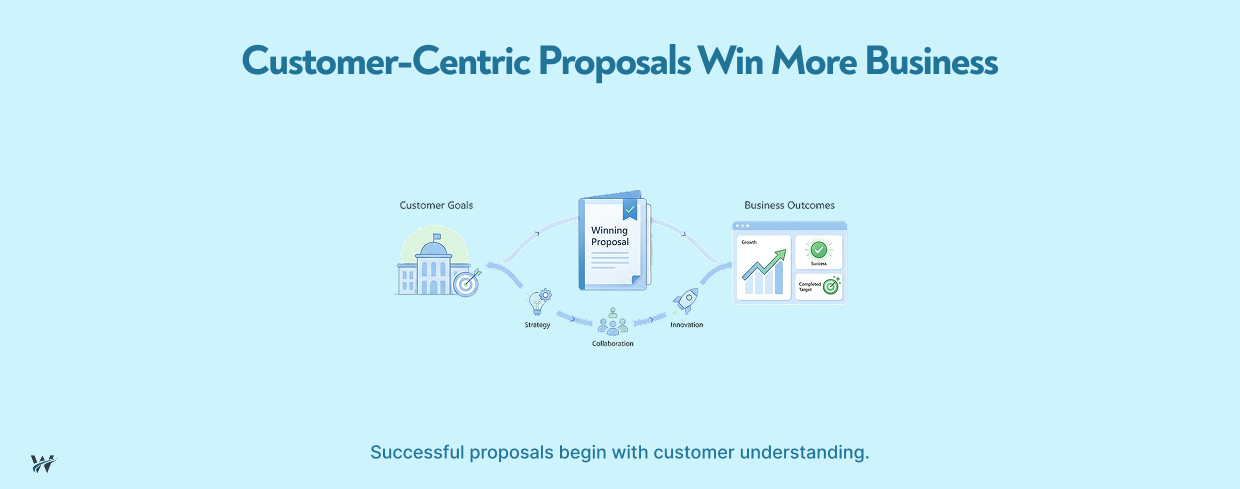
Customer-centric proposal writing shifts the focus from "who we are" to "how we solve your problem." It creates proposals that are more relevant, persuasive, and aligned with the customer's mission and evaluation criteria.
Whether you are responding to a federal solicitation, state and local government opportunity, or commercial request for proposal, understanding the customer should be at the center of your proposal strategy.
What Is Customer-Centric Proposal Writing?
Customer-centric proposal writing is the practice of developing proposal content around the customer's objectives, challenges, requirements, and desired outcomes rather than focusing primarily on the contractor's capabilities.
Instead of simply describing what your organization does, an effective proposal connects your capabilities directly to the customer's needs.
A customer-focused proposal should clearly communicate:
The goal is not to eliminate information about your organization. It is to make that information relevant to the customer.
Start by Understanding the Customer
Before writing proposal content, proposal teams should understand who they are writing for.
For government opportunities, research can include agency strategic plans, mission statements, budget documents, public reports, procurement forecasts, organizational priorities, and previous contracts.
This research helps identify the issues that matter most to the customer.
For example, if an agency is focused on improving service delivery, a proposal should explain how the proposed solution can improve efficiency, responsiveness, and user experience. Simply stating that your company provides IT services does not demonstrate how those services support the agency's mission.
The proposal should connect every major capability to a customer need.
Focus on Outcomes, Not Just Features
A common proposal mistake is listing features without explaining their value.
Instead of saying:
"Our team provides 24/7 IT helpdesk support."
Explain what that means for the customer:
"Our 24/7 IT helpdesk approach helps minimize downtime, improve user productivity, and provide continuous support for mission-critical operations."
The second approach connects the service to measurable business outcomes.
When writing proposal content, ask:
What will improve because of our solution?
Possible outcomes may include:
Outcome-focused writing makes your proposal more persuasive because it shows evaluators why your approach matters.
Use the Customer's Language
Solicitations contain terminology that should guide your proposal writing.
Review the solicitation carefully and identify recurring terms, mission objectives, technical requirements, performance expectations, and evaluation language. Use this terminology naturally throughout your response.
This does not mean copying the solicitation word for word. It means demonstrating that your team understands the customer's requirements and can respond directly to them.
For example, if the customer emphasizes "mission continuity," your proposal should explain how your staffing, technology, support, and risk-management approach contribute to mission continuity.
Using customer language also makes it easier for evaluators to see the connection between your solution and the requirements.
Address Risks Before the Customer Has to Ask
Customers want solutions, but they also want confidence that those solutions can be delivered successfully.
A strong customer-centric proposal identifies potential risks and explains how they will be managed.
Depending on the opportunity, risks may include:
Rather than simply stating that your organization has experience, explain how that experience helps reduce risk.
For example, describe your processes for resource planning, quality control, communication, escalation, cybersecurity, testing, documentation, and contingency planning.
This demonstrates that your team is thinking beyond contract award and considering successful execution.
Make Past Performance Relevant
Past performance is valuable, but only when it supports the customer's decision.
Avoid filling your proposal with unrelated project descriptions. Instead, select examples that demonstrate experience solving problems similar to those identified in the current opportunity.
A strong past-performance example should answer:
This creates a direct connection between your previous success and the customer's current requirements.
Align Every Section With Evaluation Criteria
Customer-centric proposal writing also means writing for the evaluation process.
Before finalizing a proposal, map each section to the solicitation requirements and evaluation criteria. Reviewers should not have to search for evidence that your solution meets their expectations.
Your proposal should make it easy to identify:
Requirement → Approach → Capability → Evidence → Outcome
This structure creates a logical narrative and helps evaluators understand the value of your solution.
Avoid the "We, We, We" Problem
A proposal can quickly become repetitive when every paragraph begins with statements such as:
These statements are not necessarily wrong, but excessive use makes the proposal company-centric.
Instead, shift the perspective toward the customer:
The difference may appear small, but it changes the proposal from a company brochure into a solution narrative.
Benefits of Customer-Centric Proposals
A customer-focused proposal can provide several competitive advantages:
Stronger Evaluator Engagement
Relevant content keeps evaluators focused on how your solution addresses their needs.
Better Alignment
Connecting your approach directly to requirements and evaluation criteria demonstrates responsiveness.
Clearer Value Proposition
Outcome-focused writing makes it easier for customers to understand the value you bring.
Stronger Differentiation
Instead of competing only on capabilities or price, you demonstrate a clear understanding of the customer's challenges.
Greater Credibility
Relevant evidence, measurable results, and realistic risk-management strategies build confidence in your ability to deliver.
A Simple Customer-Centric Proposal Framework
Before submitting your next proposal, use this framework:
Conclusion
Successful proposal writing is not about saying everything your company can do. It is about saying the right things that demonstrate how you can solve the customer's problem.
A customer-centric proposal puts the customer's mission, challenges, requirements, and desired outcomes at the center of the narrative. By focusing on solutions, measurable results, relevant evidence, risk management, and evaluation criteria, organizations can create proposals that are clearer, more persuasive, and more competitive.
Stop selling capabilities in isolation. Start showing customers how your solution can help them achieve their goals.
Call to Action
Ready to strengthen your next proposal?
Wexus Win Works helps organizations develop customer-focused proposals that align capabilities with requirements, communicate measurable value, and create stronger competitive positioning.
Contact Wexus Win Works today to discuss your proposal strategy and turn customer requirements into winning solutions.