
Introduction
Winning government and commercial contracts requires much more than excellent writing. Successful proposals are the result of careful planning, strategic messaging, rigorous compliance checks, and multiple rounds of objective evaluation. Even organizations with experienced proposal writers can overlook weaknesses that reduce their competitiveness if proposals are not reviewed thoroughly before submission.
This is why high-performing proposal teams rely on color team reviews as a core part of their proposal management process. Structured proposal reviews provide an organized framework for evaluating compliance, technical accuracy, responsiveness, persuasiveness, and overall proposal quality throughout the proposal development lifecycle.
Rather than waiting until the proposal is nearly complete, color team reviews introduce checkpoints that allow proposal managers, subject matter experts, capture managers, executives, and independent reviewers to identify issues early when they can still be corrected efficiently.
Whether responding to federal government opportunities, state contracts, or commercial RFPs, organizations that use structured proposal reviews consistently produce stronger, more compliant, and more persuasive proposals with higher win probabilities.
In this blog, we'll explore what color team reviews are, why they matter, the different review stages, best practices for conducting effective reviews, and how structured proposal evaluations contribute to long-term proposal success.
What Are Color Team Reviews?
Color team reviews are structured evaluation stages conducted throughout proposal development. Each review serves a specific purpose and focuses on different aspects of the proposal as it evolves from planning to final production.
Instead of relying on one final proofread, proposal teams conduct multiple scheduled reviews that progressively improve the proposal.
Each review evaluates specific areas such as:
These structured reviews create accountability while ensuring that proposals continue improving throughout development.
For organizations pursuing federal contracts, structured reviews are considered a best practice because government evaluators score proposals based on clearly defined criteria. Missing even one requirement can significantly reduce evaluation scores.
Why Structured Proposal Reviews Matter
Proposal development often involves multiple contributors working under tight deadlines.
Technical experts write solution narratives.
Proposal managers coordinate schedules.
Capture managers develop strategies.
Graphic designers prepare visuals.
Executives provide approvals.
Without formal review checkpoints, inconsistencies and compliance gaps can easily appear across sections.
Structured reviews provide an opportunity to ensure every section contributes toward one consistent message while addressing every solicitation requirement.
They also reduce the risk of submitting proposals containing:
Ultimately, structured reviews increase proposal quality while reducing submission risk.
The Different Types of Color Team Reviews
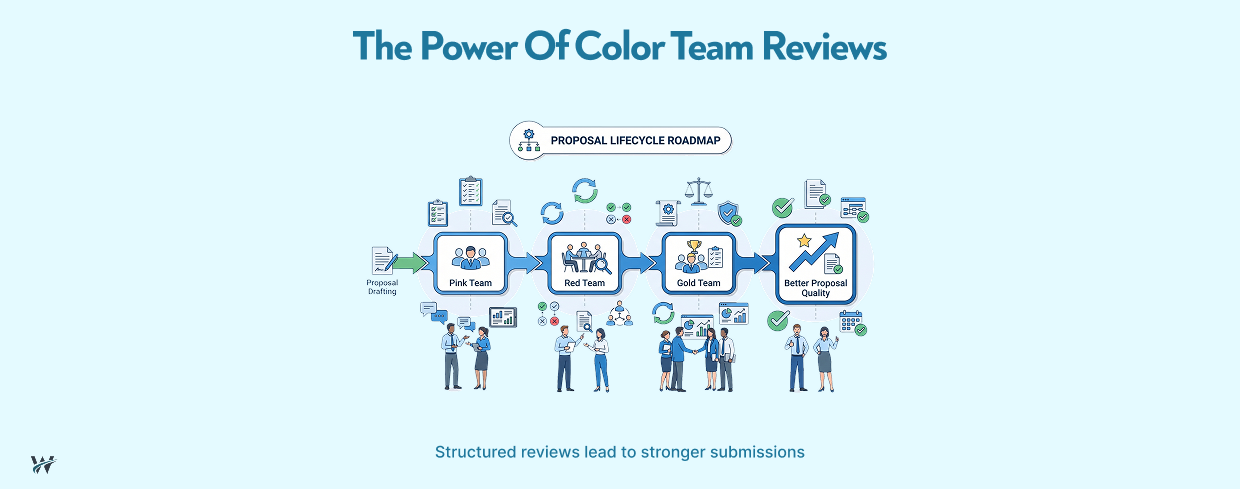
Although organizations may customize their review processes, most high-performing proposal teams use four primary review stages.
White Team Review
The White Team Review occurs during the earliest stages of proposal development.
Rather than reviewing completed content, this review focuses on planning and proposal architecture.
Typical review objectives include:
Because this review happens before writing begins, it helps eliminate confusion and ensures every contributor understands proposal objectives.
Strong planning significantly improves proposal efficiency later in the development cycle.
Pink Team Review
The Pink Team Review represents the first major evaluation of proposal content.
At this stage, sections are usually between 50% and 70% complete.
The purpose is not to critique writing style but to evaluate whether the proposal is heading in the right strategic direction.
Pink Team reviewers typically assess:
Reviewers determine whether the proposal is developing into a compelling response before significant writing effort continues.
This early feedback prevents teams from spending valuable time expanding content that may later require major revisions.
Red Team Review
The Red Team Review is considered the most comprehensive proposal evaluation.
By this stage, the proposal should be nearly complete.
Independent reviewers evaluate the proposal exactly as the customer or government evaluator would.
The review typically examines:
Red Team reviewers are encouraged to challenge assumptions and identify weaknesses objectively.
Questions commonly asked include:
Because reviewers simulate the customer's perspective, the Red Team Review often produces the most valuable improvement recommendations.
Gold Team Review
The Gold Team Review represents the executive approval stage.
Senior leadership evaluates whether the proposal aligns with corporate objectives before submission.
Executives focus on:
Rather than editing every paragraph, executives determine whether the organization is ready to submit its best possible proposal.
The Gold Team Review provides final authorization before production begins.
Benefits of Structured Proposal Reviews
Organizations investing in structured proposal reviews consistently experience measurable improvements in proposal quality and win rates.
Improved Proposal Quality
Every review identifies weaknesses that might otherwise remain hidden until after submission.
Reviewers often uncover:
Correcting these issues improves proposal clarity and professionalism.
High-quality proposals create stronger first impressions with evaluators.
Stronger Compliance
Compliance remains one of the most critical factors in proposal success.
Government evaluators frequently eliminate proposals that fail to address mandatory requirements.
Structured reviews verify:
Proposal compliance reviews significantly reduce submission risk.
Better Evaluator Experience
Proposal evaluators often review hundreds of pages within limited timeframes.
Clear organization improves readability.
Structured reviews ensure proposals include:
A proposal that is easy to evaluate often receives stronger consideration.
Reduced Proposal Risk
Color team reviews identify issues before final production.
Examples include:
Finding these issues early prevents last-minute emergencies and submission delays.
Increased Win Probability
Every review improves proposal competitiveness.
Teams refine:
The cumulative effect is a proposal that is clearer, more persuasive, and better aligned with evaluator expectations.
Best Practices for Conducting Effective Color Team Reviews
A structured review process is only effective when it is properly managed.
Use Independent Reviewers
Proposal contributors often become too familiar with the content to notice weaknesses.
Independent reviewers provide fresh perspectives.
They identify:
Organizations should involve reviewers who were not directly responsible for writing the proposal.
Establish Clear Review Objectives
Each review should have specific goals.
For example:
White Team:
Pink Team:
Red Team:
Gold Team:
Clear objectives help reviewers focus on meaningful improvements.
Provide Structured Review Guidelines
Reviewers should receive standardized evaluation criteria.
Typical review questions include:
Standardized review forms improve consistency across reviewers.
Track Findings
Every recommendation should be documented.
Proposal managers should maintain issue logs that include:
Tracking findings ensures recommendations are implemented rather than overlooked.
Schedule Reviews Early
One of the biggest proposal mistakes is conducting reviews too close to submission deadlines.
Meaningful improvements require time.
Organizations should schedule reviews with sufficient time for:
Early reviews significantly improve proposal quality.
Encourage Constructive Feedback
Successful review teams focus on improving the proposal, not criticizing writers.
Feedback should be:
Positive collaboration encourages continuous improvement throughout proposal development.
Common Mistakes to Avoid During Color Team Reviews
Even experienced proposal teams can reduce the effectiveness of reviews by making avoidable mistakes.
Some of the most common include:
Avoiding these mistakes helps organizations maximize the value of every review cycle.
Why Color Team Reviews Matter for Federal Proposal Success
Federal government proposals are evaluated using structured scoring methodologies based on strict solicitation requirements. Evaluators assess compliance, technical approach, management capability, past performance, staffing, and overall value.
Color team reviews ensure that every proposal section aligns with these evaluation factors while reinforcing the organization's win strategy.
For companies pursuing federal IT services, cybersecurity, cloud migration, Microsoft technologies, managed services, staffing, AI solutions, and digital transformation contracts, structured reviews provide a competitive advantage by ensuring proposals are complete, compliant, and persuasive.
Organizations that invest in disciplined proposal management processes are better positioned to deliver consistent, high-quality submissions that stand out in highly competitive procurement environments.
Conclusion
Successful proposal development requires more than skilled writers and compelling technical solutions. It requires a disciplined review process that continuously strengthens the proposal before submission.
Color team reviews provide structured opportunities to improve compliance, refine messaging, validate strategy, enhance readability, and reduce submission risk. By incorporating White Team, Pink Team, Red Team, and Gold Team reviews into the proposal lifecycle, organizations can identify weaknesses early, improve collaboration, and produce higher-quality proposals.
Whether pursuing federal government contracts or commercial opportunities, structured proposal reviews help teams deliver more competitive responses, increase evaluator confidence, and improve overall win probability. Investing in a formal color team review process is one of the most effective ways to elevate proposal quality and support long-term business growth.
Call to Action
Looking to improve your proposal development process and increase your contract win rate?
Our proposal management experts provide comprehensive proposal support, including color team reviews, compliance assessments, proposal writing, capture strategy, content development, and executive reviews. We help organizations produce compliant, persuasive, and competitive proposals for federal, state, and commercial opportunities.
Contact us today to learn how our proposal management services can strengthen your next proposal and improve your chances of winning more business.