
Introduction
Federal proposal development is a demanding process that requires coordination across multiple teams, strict compliance with solicitation requirements, and the ability to produce high-quality responses under tight deadlines. Yet many organizations continue to approach each proposal as a completely new effort, recreating resumes, project descriptions, management approaches, technical narratives, and corporate information every time they pursue an opportunity.
This approach consumes valuable resources, increases the risk of inconsistencies, and often creates unnecessary stress for proposal teams.
As competition for government contracts continues to increase, contractors must find ways to improve proposal efficiency without sacrificing quality. One of the most effective solutions is implementing a centralized proposal content library.
A well-structured proposal content library enables organizations to reuse approved content, streamline proposal development, improve consistency, and accelerate response times. It also supports better collaboration among capture managers, proposal managers, technical writers, subject matter experts, and business development teams.
For organizations pursuing federal, state, and local government opportunities, a proposal content library can become a strategic asset that improves proposal quality while reducing the time and effort required to respond to Requests for Proposals (RFPs).
What Is a Proposal Content Library?
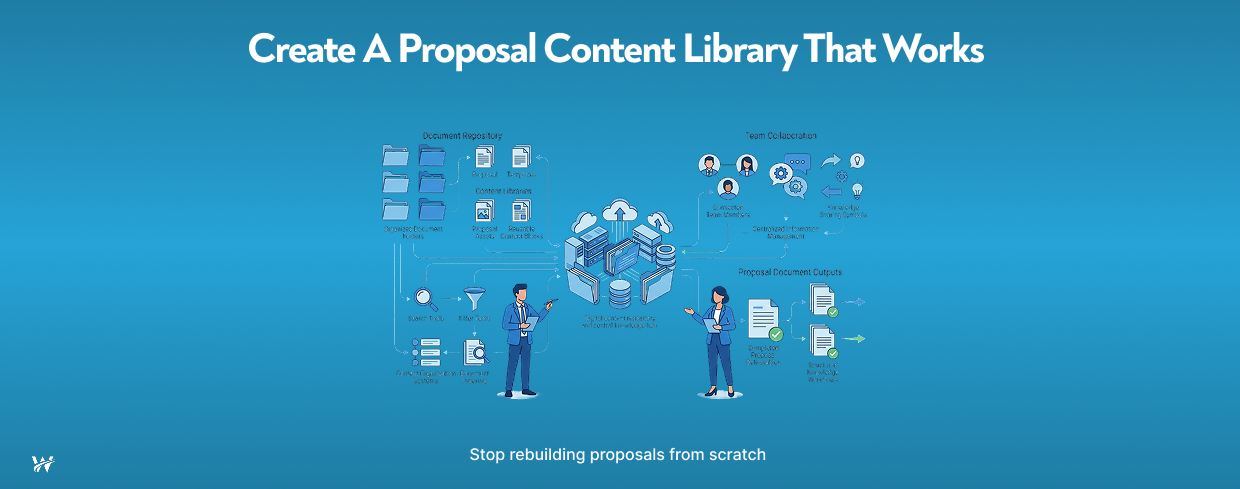
A proposal content library is a centralized repository of approved proposal materials that can be reused during proposal development.
Rather than creating content from scratch for every opportunity, proposal teams can access pre-approved materials that have already been reviewed for accuracy, compliance, and quality.
The goal is not to copy and paste entire proposals. Instead, the library serves as a knowledge management system that provides reusable building blocks for creating customized and compliant responses.
A proposal content library may include:
By maintaining a centralized collection of approved materials, organizations can significantly improve proposal development efficiency while ensuring consistency across submissions.
Why Proposal Content Libraries Matter
Organizations that rely on scattered files, outdated documents, and individual knowledge often struggle to maintain proposal quality.
Proposal content libraries help solve several common challenges.
Eliminating Redundant Work
Many proposal teams repeatedly create the same content for multiple opportunities.
For example, a project manager may rewrite a past performance narrative several times during a single year. Human resources may repeatedly update resumes for key personnel. Technical experts may recreate management approaches that have already been approved in previous proposals.
This duplication wastes valuable time and increases proposal costs.
A centralized content library eliminates much of this redundant effort by making approved materials easily accessible.
Supporting Faster Proposal Turnarounds
Government solicitations often have aggressive response deadlines.
Proposal teams that spend days searching for resumes, project descriptions, and technical narratives lose valuable time that could be spent tailoring responses to customer requirements.
A proposal content library allows teams to quickly locate and adapt existing content, accelerating the proposal development process.
Improving Proposal Quality
Quality is one of the most important factors in proposal success.
When content is developed from scratch under deadline pressure, errors and inconsistencies become more likely.
Using reviewed and approved content reduces risk while improving overall proposal quality.
Key Benefits of a Proposal Content Library
Organizations that invest in proposal content management often experience significant operational and competitive advantages.
Faster Proposal Development
One of the most immediate benefits is increased speed.
Instead of recreating content, proposal teams can leverage existing materials to build responses more efficiently.
This enables organizations to:
Faster proposal development also allows teams to spend more time on strategic activities such as solution development, customer-focused messaging, and proposal reviews.
Improved Consistency
Consistency is critical in government proposal writing.
When multiple authors contribute to a proposal, inconsistencies can emerge in:
A proposal content library ensures that approved language and messaging remain consistent across submissions.
This consistency strengthens credibility and presents a more professional image to evaluators.
Higher Quality Responses
Proposal quality improves when organizations use content that has already undergone review and approval processes.
Approved content typically contains:
As a result, proposal teams spend less time correcting errors and more time enhancing proposal competitiveness.
Better Collaboration Across Teams
Proposal development often involves collaboration among numerous stakeholders.
These may include:
A centralized proposal content library provides a shared resource that improves coordination and communication.
Everyone works from the same source of truth.
Knowledge Retention
Employee turnover can create significant challenges for organizations.
When proposal knowledge resides primarily with individual employees, valuable information can be lost when staff members leave.
A proposal content library preserves institutional knowledge by capturing critical content and making it available to future proposal teams.
This knowledge retention supports long-term organizational growth and stability.
Improved Compliance
Government proposals require strict compliance with solicitation instructions.
Proposal content libraries can include approved compliance language and templates that help teams maintain consistency with regulatory requirements and customer expectations.
This reduces the likelihood of non-compliant responses.
Essential Components of an Effective Proposal Content Library
Not all content libraries deliver the same value.
Successful libraries typically include several key components.
Past Performance Repository
Past performance is one of the most important evaluation factors in federal contracting.
A strong repository should include:
These narratives should be categorized by industry, agency, contract type, and capability area.
Key Personnel Resume Database
Many proposals require resumes for key personnel.
Maintaining a current database ensures that proposal teams can quickly access approved resumes without requesting updates for every opportunity.
Each resume should include:
Technical Content Repository
Technical approaches often contain reusable methodologies and best practices.
Examples include:
These materials provide a foundation that can be customized for specific opportunities.
Corporate Information Library
Proposal teams frequently require organizational information such as:
Keeping this information centralized ensures accuracy and consistency.
Graphics and Visual Assets
Proposal graphics often require substantial effort to create.
A content library should include:
These resources help improve proposal readability and visual appeal.
Best Practices for Building a Proposal Content Library
Creating a proposal content library is only the first step.
Maintaining its effectiveness requires proper governance and management.
Maintain Version Control
One of the biggest risks associated with content libraries is outdated information.
Without version control, proposal teams may unknowingly use obsolete content.
Effective version control should include:
This ensures that teams always use the most current materials.
Organize Content by Topic
A content library is only valuable if users can quickly find information.
Content should be organized into logical categories such as:
Search functionality and tagging systems can further improve accessibility.
Update Content Regularly
Proposal content should never remain static.
Organizations should review and update materials regularly, especially after:
Routine updates ensure continued accuracy and relevance.
Establish Content Ownership
Every content category should have a designated owner.
Responsibilities may include:
Clear ownership improves accountability and content quality.
Standardize Formatting
Consistent formatting helps improve professionalism and usability.
Standardization should address:
Consistency supports stronger proposal presentation.
Implement Review Processes
Content should undergo periodic reviews to verify:
Regular reviews help prevent outdated information from entering proposal submissions.
Technology Solutions for Proposal Content Management
Many organizations use specialized tools to manage proposal content libraries.
Common solutions include:
These platforms provide features such as:
Selecting the right technology depends on organizational size, proposal volume, and operational requirements.
Common Mistakes to Avoid
Even well-intentioned organizations can encounter challenges when implementing content libraries.
Common mistakes include:
Treating the Library as a Storage Folder
A proposal content library should be actively managed, not simply used as a document archive.
Failing to Update Content
Outdated information reduces credibility and creates compliance risks.
Lack of Ownership
Without clear accountability, content quality can deteriorate over time.
Poor Organization
Difficult-to-find content reduces efficiency and discourages adoption.
Excessive Content Duplication
Multiple versions of similar content create confusion and increase maintenance requirements.
Avoiding these issues helps maximize the value of the content library.
How Proposal Content Libraries Improve Win Rates
While content libraries primarily improve efficiency, they can also support higher proposal win rates.
By reducing time spent searching for information and recreating content, proposal teams can focus more on:
These activities directly contribute to stronger proposals and improved competitiveness.
Organizations that consistently produce high-quality, compliant, and customer-focused proposals are often better positioned to win government contracts.
Conclusion
Building a proposal content library is one of the most effective ways to improve proposal efficiency, consistency, and quality. Instead of recreating content for every opportunity, organizations can leverage approved materials that accelerate proposal development while reducing errors and inconsistencies.
A well-managed proposal content library supports faster response times, stronger collaboration, improved compliance, and better knowledge retention. It also enables proposal teams to focus on strategic proposal development activities that enhance competitiveness and increase win probability.
As government contracting continues to become more competitive, organizations that invest in structured proposal content management will be better positioned to pursue opportunities efficiently and deliver high-quality proposal submissions.
Call to Action
Winning government contracts requires more than great writing. It requires efficient proposal processes, organized content management, and the ability to respond quickly without sacrificing quality.
Wexus helps government contractors streamline proposal development through proposal management services, content library development, capture management support, and federal proposal consulting.
Contact Wexus today to learn how we can help your organization build a proposal content library that improves efficiency, strengthens proposal quality, and increases your ability to compete for government opportunities.