
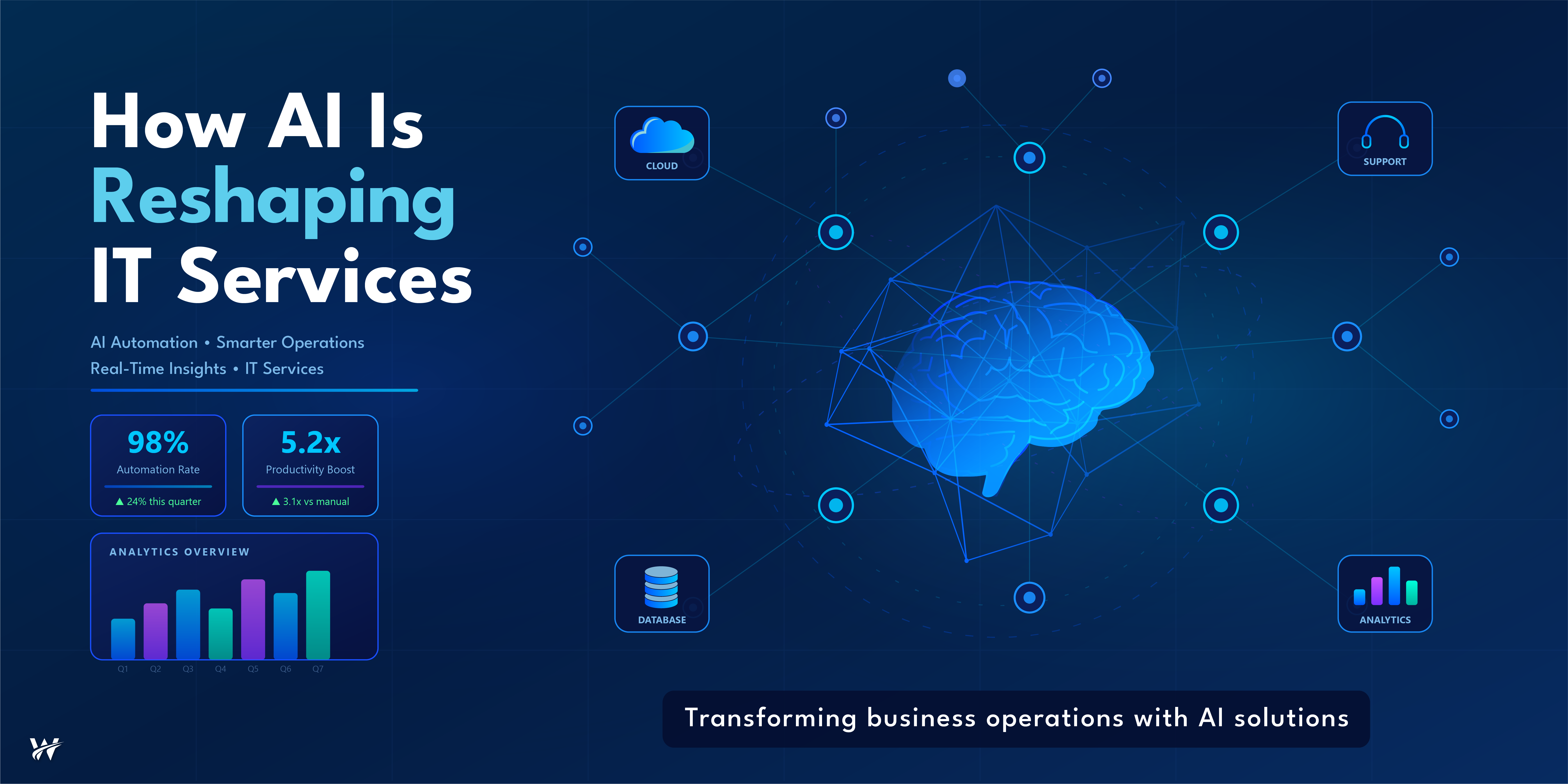
Published: 01 June 2026, 09:00PM
Introduction
Artificial Intelligence (AI) is rapidly transforming the global business landscape. What was once considered a futuristic concept is now a practical business tool helping organizations improve efficiency, automate operations, and enhance customer experiences. From healthcare and retail to government agencies and financial institutions, companies are integrating AI-driven technologies into their daily operations to remain competitive in an increasingly digital world.
In the IT services industry, AI is revolutionizing how businesses manage infrastructure, support users, secure systems, analyze data, and streamline workflows. Organizations are leveraging intelligent automation to reduce operational costs, improve productivity, and accelerate decision-making processes.
Modern enterprises are also combining AI with cloud computing, cybersecurity solutions, Microsoft technologies, and managed IT services to create scalable, secure, and highly efficient digital environments. As businesses continue their digital transformation journeys, AI is becoming a core driver of operational success.
This blog explores how AI in IT services is reshaping business operations, the benefits of intelligent automation, real-world use cases, challenges organizations face, and what the future holds for AI-powered IT environments.
Understanding AI in IT Services
Artificial Intelligence refers to computer systems and software capable of performing tasks that traditionally require human intelligence. These tasks include learning, problem-solving, data analysis, language processing, and decision-making.
In IT services, AI technologies are commonly used to automate repetitive processes, improve IT support operations, enhance cybersecurity, and optimize infrastructure management.
AI-powered solutions often include:
IT service providers are integrating these technologies into enterprise environments to improve service delivery and operational efficiency.
How AI Is Changing IT Services
AI is transforming the IT services industry by enabling smarter systems, faster operations, and more proactive support models. Traditional IT management often relied heavily on manual processes, reactive troubleshooting, and time-consuming administrative tasks. AI introduces automation and intelligence into these operations.
Automating Routine IT Tasks
One of the biggest impacts of AI is automation. IT teams spend significant time handling repetitive activities such as:
AI-powered automation tools reduce manual workloads and allow IT professionals to focus on strategic initiatives rather than repetitive maintenance tasks.
Automation also improves consistency and minimizes human error, leading to more reliable operations.
Enhancing IT Support Services
AI is improving helpdesk and IT support experiences through intelligent chatbots and virtual assistants. Businesses are using AI-driven support systems to provide faster responses and 24/7 customer assistance.
AI support solutions can:
This significantly reduces response times and improves user satisfaction.
Organizations using Microsoft 365, Dynamics 365, SharePoint, and cloud-based collaboration platforms are increasingly integrating AI support capabilities into their digital workplaces.
Predictive Maintenance and Monitoring
Traditional IT monitoring systems often react to issues after they occur. AI-powered predictive analytics changes this model by identifying risks before systems fail.
AI can monitor:
Predictive systems analyze patterns and detect anomalies that may indicate future problems.
This proactive approach helps businesses minimize downtime and improve system reliability.
Smarter Data Management
Modern organizations generate massive amounts of business data every day. AI-powered analytics tools help companies process, organize, and interpret this information quickly.
AI solutions help businesses:
Data analytics combined with AI enables faster and smarter business strategies.
Key Benefits of AI in IT Services
Businesses investing in AI-driven IT services are seeing measurable improvements in operational performance, customer experiences, and overall business efficiency.
AI systems process vast amounts of information within seconds, helping organizations make informed decisions quickly.
Instead of manually reviewing reports or analyzing spreadsheets, AI tools provide real-time insights that improve strategic planning and operational responsiveness.
For example, AI-powered business intelligence platforms can identify performance issues, sales trends, or customer behavior patterns instantly.
Faster decision-making helps organizations remain agile and competitive.
Automation reduces the need for repetitive manual work, increasing productivity across departments.
AI improves efficiency by:
Organizations using managed IT services and cloud automation platforms can scale operations more effectively while reducing administrative overhead.
AI-powered support systems improve helpdesk operations and customer service experiences.
Benefits include:
AI chatbots are especially useful for handling common IT requests while human technicians focus on complex technical problems.
AI-driven analytics provide businesses with actionable insights that support growth and innovation.
Advanced analytics tools can uncover:
These insights allow organizations to make strategic decisions backed by data rather than assumptions.
Cybersecurity remains one of the biggest concerns for modern businesses. AI is playing a major role in improving threat detection and incident response capabilities.
AI-powered cybersecurity systems can:
Organizations using cloud services, Microsoft Azure, and hybrid environments benefit from AI-driven security monitoring and automated threat intelligence.
AI automation reduces labor-intensive tasks, improves operational efficiency, and minimizes downtime.
This leads to lower operational costs through:
Businesses can reinvest these savings into innovation and digital transformation initiatives.
Industries Using AI Solutions
AI adoption is expanding across multiple industries as organizations seek smarter and more efficient business operations.
Healthcare
Healthcare providers use AI for:
AI helps improve patient outcomes while reducing administrative workloads.
Financial Services
Banks and financial institutions use AI for:
AI enables faster and more secure financial operations.
Retail
Retail companies leverage AI to improve:
AI helps retailers enhance customer experiences and increase sales efficiency.
Manufacturing
Manufacturers use AI-powered automation for:
AI improves operational efficiency and reduces production downtime.
Government IT
Government agencies are increasingly investing in AI technologies to modernize public services and improve operational efficiency.
AI supports:
Federal and state agencies are integrating AI into digital transformation strategies to improve service delivery.
Logistics and Transportation
Logistics companies use AI to optimize:
AI helps improve operational speed and reduce transportation costs.
AI and Cloud Computing
Cloud computing and AI work together to create scalable and intelligent business environments.
Cloud platforms such as Microsoft Azure, AWS, and Google Cloud provide businesses with access to AI services without requiring extensive on-premise infrastructure.
Benefits of cloud-based AI solutions include:
Organizations are increasingly adopting cloud-based AI platforms to accelerate digital transformation initiatives.
Microsoft technologies, including Azure AI services, Power BI, Power Apps, and Dynamics 365, are helping businesses integrate intelligent automation into their daily operations.
AI in Managed IT Services
Managed IT service providers are incorporating AI into service delivery models to improve operational performance and customer experiences.
AI-powered managed services include:
Managed service providers (MSPs) use AI to deliver proactive support rather than reactive troubleshooting.
This approach helps businesses maintain stable and secure IT environments while reducing downtime.
Challenges of AI Adoption
While AI offers significant benefits, businesses may face challenges during implementation.
Data Privacy and Security
AI systems often process large volumes of sensitive business and customer data. Organizations must ensure proper data governance and compliance with privacy regulations.
Cybersecurity and data protection remain critical priorities during AI adoption.
Integration Complexity
Integrating AI with existing IT systems can be complex, especially for organizations using legacy infrastructure.
Businesses may require:
Successful implementation often depends on strategic planning and experienced IT partners.
Workforce Adaptation
AI changes how employees work, which may require workforce training and change management initiatives.
Organizations should focus on:
AI is designed to enhance workforce productivity rather than replace employees entirely.
Cost of Implementation
Although AI delivers long-term savings, initial investments may include:
Businesses should evaluate ROI and prioritize scalable AI solutions aligned with their operational goals.
Future of AI in IT Services
The future of AI in IT services is expected to be driven by continuous innovation, automation, and intelligent decision-making.
Emerging trends include:
Businesses will increasingly rely on AI to support scalability, operational efficiency, and competitive advantage.
Organizations that adopt AI strategically will be better positioned to adapt to evolving market demands and technological advancements.
AI will continue transforming how businesses manage operations, analyze information, and deliver digital services.
Why Businesses Should Invest in AI-Powered IT Services
Businesses investing in AI-powered IT services gain several competitive advantages:
AI is no longer optional for organizations seeking long-term digital growth and innovation.
Partnering with experienced IT consulting firms and managed service providers can help businesses successfully implement AI solutions tailored to their operational requirements.
Conclusion
Artificial Intelligence is reshaping the IT services industry by enabling smarter operations, intelligent automation, and faster decision-making. Businesses across industries are leveraging.
AI technologies to improve efficiency, enhance customer experiences, strengthen cybersecurity, and optimize business performance.
From predictive analytics and automated IT support to cloud-based AI platforms and intelligent workflows, AI is becoming a critical component of modern business operations.
As organizations continue their digital transformation journeys, AI-powered IT services will play an increasingly important role in driving innovation, scalability, and long-term success.
Companies that embrace intelligent automation today will be better prepared for the future of business technology.
Call to Action
Looking to integrate AI solutions into your business operations?
Our IT consulting and managed services experts help organizations implement AI-powered technologies, cloud solutions, cybersecurity strategies, Microsoft platforms, and intelligent automation systems that improve efficiency and support long-term growth.
Contact us today to learn how AI-driven IT services can transform your business operations and accelerate digital transformation.